It is apparent that Abel contributed significantly to the field of Mathematics. Unfortunately for Abel, and perhaps better for us, he halted his pursuit of mathematical physics after multiple unsuccessful investigations into mathematical modeling of our physical world. Moreover, he decided to switch to a focus in pure mathematics, which is the area for which he is best known for. The most successful areas of research pursued by Abel were: Transcendental functions (ie. elliptic integrals, and abelian integrals) as well as solutions to rigorous algebraic equations by radicals, and finally theory for power series and its limits.
In Abel's work on elliptic integrals, the first created a special integral which when given constants e=0 and c=1 is able to calculate the arc length of a circle (Figure 1.1) and although the
parameters in this particular example are arbitrary integers, it is possible to take this function onto the complex plane, where it is still used today in Calculus II and Complex Analysis (Note: This function requires an extension onto the complex plane, out of the scope of this paper).
Algebra is an area for which we all can recall from high school, where we would be required to work out that pesky quadratic formula, to find the roots of a polynomial equation (for order 2 polynomials). However, Abel found polynomials of degree 5 to be much more interesting. In 1824, Abel completed a proof for which he showed that in general, polynomial equations of degree 5 or higher with arbitrary coefficients contain, no solutions.
Lastly, one of Abel's 'greatest hits' was his work on the power series. In particular, what is now called 'Abel's Theorem' related the the limit of a power series to the sum of its coefficients. More formally, in Figure 1.2 we see that the limit of a power series, with coefficients (a_k), which converges and is continuous, then we have Abel's Theorem in Figure 1.3 (below)
(Figure 1.3)
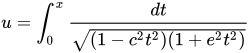
In Abel's work on elliptic integrals, the first created a special integral which when given constants e=0 and c=1 is able to calculate the arc length of a circle (Figure 1.1) and although the
parameters in this particular example are arbitrary integers, it is possible to take this function onto the complex plane, where it is still used today in Calculus II and Complex Analysis (Note: This function requires an extension onto the complex plane, out of the scope of this paper).
Algebra is an area for which we all can recall from high school, where we would be required to work out that pesky quadratic formula, to find the roots of a polynomial equation (for order 2 polynomials). However, Abel found polynomials of degree 5 to be much more interesting. In 1824, Abel completed a proof for which he showed that in general, polynomial equations of degree 5 or higher with arbitrary coefficients contain, no solutions.
Lastly, one of Abel's 'greatest hits' was his work on the power series. In particular, what is now called 'Abel's Theorem' related the the limit of a power series to the sum of its coefficients. More formally, in Figure 1.2 we see that the limit of a power series, with coefficients (a_k), which converges and is continuous, then we have Abel's Theorem in Figure 1.3 (below)
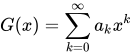
(Figure 1.3)
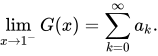 (Figure 1.3)
Works Cited
“Abel, Niels Henrik (1802-1829) -- from Eric Weisstein's World of Scientific Biography.” Scienceworld.wolfram.com, scienceworld.wolfram.com/biography/Abel.html.
“Abel Theorem.” Abel Theorem - Encyclopedia of Mathematics, www.encyclopediaofmath.org/index.php/Abel_theorem.
Britannica, The Editors of Encyclopaedia. “Niels Henrik Abel.” Encyclopædia Britannica, Encyclopædia Britannica, Inc., 18 Oct. 2017, www.britannica.com/biography/Niels-Henrik-Abel.
Comments
Post a Comment